
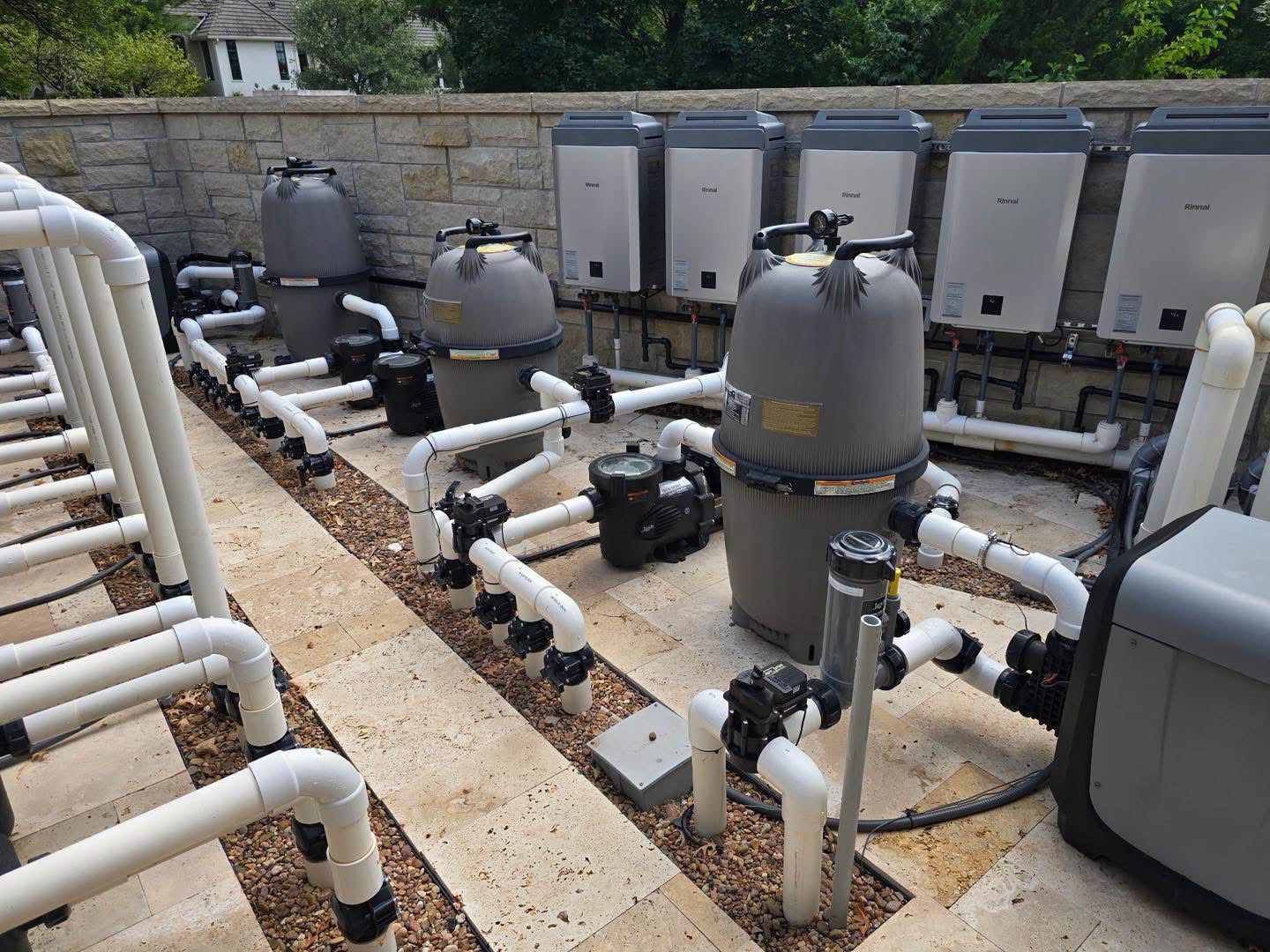
Most repairs fail twice. We find the cause the first time.
Diagnosed to the root. Priced before we touch it. Fixed once. Anything pool or spa related — equipment, plumbing, structure, electrical, automation. You approve a written scope before a single tool comes off the truck.
A repair that doesn’t last is just an expensive visit.
Most pool companies treat symptoms. A pump is making noise, so they replace the pump. The noise comes back three months later — because the real issue was a failing bearing that had already destroyed the shaft seal, or a suction-side restriction that was never checked.
You paid for a pump. You did not buy a fix.
We diagnose to the root, write the full scope, price it before anyone touches your equipment, and fix it once.
If we cannot identify the cause, we tell you that too — in writing, with what we tested and what we ruled out. A technician who says “we’ll swap it and see” is billing you for his own uncertainty. That is not a diagnosis. That is a guess with an invoice attached.
- Verbal estimate over the phone, sight unseen
- “We’ll know more once we get there”
- Time and materials, meter running
- Parts replaced until the symptom stops
- Invoice arrives with line items you never approved
- No record of what was tested or why
- Same failure returns in one season
- On-site diagnostic with instruments, not opinions
- Written Solution with full scope before work starts
- Fixed, approved price — you authorize it in the portal
- The failed component and the condition that killed it
- Nothing outside the approved scope gets billed. Ever.
- Test readings, photos, and notes filed permanently
- Fixed once, documented forever
If it is pool or spa related, we repair it.
Residential and commercial. Equipment we installed and equipment we did not. Systems built last year and systems built in 1988 that nobody else will touch.
Pumps, filters & heat
Pumps, motors, variable-speed drives, filters, gas heaters, heat pumps, salt systems, chlorinators, chemical controllers, and automation hardware. Rebuild where rebuilding is right, replace where it is not — and we will tell you which is which.
Leaks, valves & flow
Leak detection and repair, valves, multiports, 3-way and 2-way diverters, actuators, suction-side restrictions, return lines, skimmer throats, main drains, and equipment-pad re-plumbs sized for actual design velocity.
Shell, tile & deck
Structural cracks, tile and coping repair or replacement, plaster and pebble patching, hollow-spot remediation, expansion joints, deck settlement, and bond-beam damage.
Power, GFCI & grid
GFCI faults, nuisance tripping, equipotential bonding grid failures, pool and landscape lighting, niche and conduit moisture intrusion, control wiring, and subpanel issues. This is the category most companies quietly skip.
Attached & standalone
Jets, circulation and blower pumps, heaters and heat exchangers, control packs, topside panels, shells, plumbing, and spillover systems. Attached spas, standalone hot tubs, swim spas, and commercial therapy units.
Panels & integrations
OmniLogic, EasyTouch, IntelliCenter, IntelliTouch, AquaLink, ProLogic, and third-party systems. Board-level diagnosis, actuator and relay faults, firmware, comms wiring, and app or network connectivity.
We do not “see what we find when we get there.” The scope is written before the work starts.
A diagnosis is a measurement, not an opinion.
Anyone can look at a pump and say it sounds bad. A diagnosis means numbers — and numbers that go in your file, so the next technician (including ours) starts where we left off instead of starting over.
Pressure differential & flow
Filter pressure against clean-baseline, suction vacuum, and flow rate through the system. A heater that short-cycles and a filter that needs cleaning look identical from the deck and are nothing alike on a gauge.
Amp draw & insulation resistance
Actual amperage against motor nameplate, voltage under load, insulation resistance, and bonding continuity across the equipotential grid. This is how a breaker trip gets traced to a light niche instead of guessed at.
Isolation & pressure testing
Static water-loss testing to separate evaporation from a real leak, then line-by-line pressure isolation to identify which line is failing before anything gets cut, dug, or jackhammered.
Gas, stack & water balance
Gas supply pressure, stack temperature, and high-limit behavior on heaters. Full water chemistry including LSI, because a heat exchanger that failed at four years old usually died of chemistry, not of age.
Every reading we take goes in your portal. Not a summary. The numbers.
The symptom is almost never the problem.
Here is what your pool is telling you, what most companies do about it, and what we test instead. If you have been quoted any of the responses in the second column without the tests in the third, you were quoted a guess.
| What you notice | The usual response | What we test | What it usually is |
|---|---|---|---|
| Pump is loud | “You need a new pump.” | Amp draw, bearing temp, suction vacuum, impeller load | Bearing failure caused by a leaking shaft seal, or cavitation from a suction-side restriction. Replacing the pump without fixing the restriction kills the new one too. |
| Pool is losing water | “The shell is cracked.” | Static bucket test, line-by-line pressure isolation, acoustic locate | A return fitting, a separated skimmer throat, or a valve bypassing. The shell is the least common answer and the most expensive one to be wrong about. |
| Heater keeps shutting off | “The heat exchanger is shot.” | Flow rate, gas supply pressure, stack temp, pressure switch, bypass | Low flow tripping the high-limit — usually a dirty filter, a closed valve, or undersized plumbing. The exchanger is often fine. |
| Salt cell reads low | “Time for a new cell.” | Cell voltage, plate condition, salinity, water temp, flow switch | Scaled plates or a failing flow switch. Cells are consumables, but they get sold years before they are actually dead. |
| Breaker keeps tripping | “Just reset it.” | Insulation resistance, bonding continuity, moisture intrusion | Water in a light niche, a degraded conduit seal, or a failed motor winding. A GFCI that trips is doing its job — resetting it repeatedly is a safety issue, not an inconvenience. |
| Automation “went crazy” | “Factory reset it.” | Firmware, actuator feedback, relay contacts, comms wiring | A failed actuator or a corroded relay that the panel reports as a logic fault. Resetting erases your configuration and fixes nothing. |
| Water turns green fast | “Add more chlorine.” | Turnover rate, CYA, LSI, filter condition, run-time verification | Locked-out chlorine from high stabilizer, or a turnover problem — the water is not actually being filtered as often as the timer suggests. |
← Scroll table →
No surprises. No mystery invoices. No “we’ll know more once we’re there.”
Eight steps. Every one of them leaves a record you can open, read, and keep. You will never have to call and ask what is happening with your own repair.
Account Setup
You create your account in the client portal. This is not paperwork for our benefit — it is the container every photo, reading, Solution, work order, and message lives in for as long as you own the property.
- Property details and equipment recorded once, not re-asked every visit
- Your preferred contact method set on day one
- Full history stays with the address, and transfers if you sell
- Portal login at rocketcitywaterwizards.mypoolportal.com
- A permanent, exportable record of every job on your property
Diagnosis
A technician comes out and tests. Pressures, amp draw, flow, continuity, chemistry — whatever the failure calls for. We identify the failed component and the condition that caused it to fail, because fixing one without the other is how you end up here again next season.
- Instrument readings recorded, not estimated
- Photographs of the actual condition, taken on your equipment pad
- If the cause cannot be confirmed, we say so in writing and tell you what it would take to confirm it
- Written findings with the actual test values
- Dated photos of the failure, uploaded to your portal
Solution (Quote)
We send a formal Solution to your portal. It carries the complete scope of work, the parts, the labor, our company credentials, our insurance information, and the terms. Nothing is left to interpretation and nothing is added later.
- Full scope in plain language — what we will do and what we will not
- Parts specified by manufacturer and model, not “a pump”
- License, SDVOSB status, and current certificate of insurance attached
- A fixed price, not a range
- The written Solution, timestamped in your portal
- Our AL license 2608580 and insurance certificate — issued by our carrier, not by us
Your Approval
You review the Solution and approve it in the portal. Work does not begin until you do. There is no verbal authorization, no “we’ll sort the paperwork later,” and no pressure to decide on the spot while a technician stands in your driveway.
- Approve, decline, or ask questions — all in writing
- Decline any line item you do not want done
- Your approval is timestamped and stored permanently
- A record of exactly what you authorized, and when
- Proof that nothing was performed outside of it
Active Job
Your approved Solution converts into an Active Job in our operations system. This is the moment your repair stops being a conversation and becomes a tracked commitment with an owner, a scope, and a clock on it.
- Parts ordered or pulled against the approved scope
- Job assigned to a technician qualified for that specific system
- Status visible to you — no calling in to ask
- Confirmation that the job is active, with its scope locked to what you approved
Work Order
A detailed work order is generated directly from the approved Solution. The technician on your property works from that document. He is not improvising, and he is not authorized to expand it.
- Generated from your approved scope — it cannot silently drift
- Parts, torque and setup specs, and test criteria included
- Completion requires verification readings, not just “done”
- The completed work order with post-repair test results attached
Scheduling
The work order goes on the schedule. You get the date and a three-hour arrival window. Not a day. Not “morning-ish.” A three-hour window, committed in writing.
- Date and three-hour window confirmed in the portal
- Parts verified in hand before your date is set — we do not book a job we cannot finish
- If anything moves, you hear it from us first
- A confirmed date and a three-hour arrival window
Day of Repair
You get a text from our toll-free number when the technician is en route. No guessing. No rearranging your entire day around someone else’s route. The work is performed to the approved scope, tested under load, and documented before the truck leaves.
- En-route text from (833)H20•WZRD | (833)420•9973
- Repair completed to the approved scope — no more, no less
- System tested under load and verified before sign-off
- Before and after photos and technician notes uploaded to your portal
- En-route notification from our toll-free number
- Before and after photographs in your portal
- Post-repair verification readings you can compare against the diagnosis
All of this lives in your client portal.
Every Solution, approval, work order, technician note, test reading, and photograph. Open it two years from now and see exactly which capacitor we installed and what the amp draw was afterward. rocketcitywaterwizards.mypoolportal.com
Diagnosed to the root. Priced before we touch it. Fixed once.
This is not a slogan. It is an operating constraint we hold ourselves to, and it costs us money on the days we get it wrong. That is what makes it worth something.
We do not start work on a time-and-materials basis and bill you while we figure it out. Diagnosis is a defined step with a defined cost, disclosed before we schedule it.
The Solution you approve is the scope we execute. Not a starting point. Not an estimate that grows. The number you approved is the number on the invoice.
If we discover an issue outside the approved scope, work stops. We document it, send a revised Solution, and wait for your approval before continuing. You are always allowed to say no, or not yet.
Photos, technician notes, and post-repair verification readings are uploaded to your portal on every visit. If it is not in the file, we did not do it.
This is how we break the cycle of repeat failures most pool owners have simply accepted as normal. It is not normal. It is just common.
We triage by risk, not by who called first.
Anyone who promises everyone same-day service is lying to somebody. Here is the honest order of operations, so you know where your situation actually sits before you call.
Safety
- Any electrical fault or repeated GFCI trip
- Bonding or equipotential grid failure
- Missing, cracked, or non-compliant drain covers
- Suction entrapment risk of any kind
- Exposed or damaged conduit and wiring
Active loss
- Active leaks losing measurable water daily
- Heater failure with a hard freeze forecast
- Total circulation loss
- Commercial systems facing a health-department closure
- Equipment failure actively damaging other equipment
Function & comfort
- Automation and app connectivity faults
- Lighting and color control
- Spa jets, blowers, and water features
- Cosmetic tile, coping, and surface work
- Planned upgrades and efficiency retrofits
When you call, you get a realistic window — not an optimistic one designed to win the booking and disappoint you later.
Communication is a deliverable, not a courtesy.
The most common complaint in this industry is not bad work. It is silence — not knowing whether anyone is coming, what was done, or what it will cost. We treat that as a defect.
Every Solution, approval, work order, and photo lives in your portal. If it matters, it is in writing.
You receive a text from our toll-free number when the technician is on the way — every time.
Not all-day windows. You should not have to burn a vacation day for a capacitor.
If a part is delayed or a date moves, you hear it from us first, in writing, before it affects you.
Questions people actually ask.
Do you charge a diagnostic fee?
Yes. Diagnosis is skilled work performed with real test equipment, and it is the part that determines whether your repair holds. The fee is disclosed before we schedule — never a surprise on the invoice — and it is credited toward the repair when you approve the Solution. Companies that diagnose “for free” recover that cost somewhere, and it is usually inside a part you did not need.
What if you find more problems once you start?
We stop. We photograph and document the finding, then send a revised Solution to your portal for approval before another minute of labor is billed. You will never open an invoice containing work you did not authorize. If the new finding is not urgent, we will tell you that as well — you are allowed to defer it, and we will not pressure you.
How fast can you usually get out?
We triage by risk. Electrical faults, bonding problems, and anything with a safety dimension move to the front of the line. Active leaks and heater failures ahead of a freeze come next. Comfort and convenience items are scheduled in order. When you call, we give you a realistic window rather than an optimistic one, and once your date is set you get a three-hour arrival window with it.
Do you repair spas and hot tubs?
Yes — attached spas, standalone hot tubs, swim spas, and commercial therapy units. Jets, circulation pumps, blowers, heaters, control packs, topside panels, shells, and plumbing. If it holds heated water and moves it under pressure, it is in scope.
Do you work on commercial systems?
Yes. HOA, hotel, apartment, municipal, and therapy pools. Commercial work carries additional documentation requirements: records suitable for health-department review, chemical controller calibration, and drain and entrapment compliance. We carry the licensing and insurance required to be on a commercial property, and both are attached to every Solution we send.
Will you work on equipment you did not install?
Almost always, including systems well past their support life that other companies have declined. The exception is equipment that cannot be brought to a safe, code-compliant condition — in that case we will tell you plainly, in writing, what it would take to make it safe rather than performing a repair that leaves a hazard in place.
Can I see previous work and photos in the portal?
Yes, permanently. Every Solution, approval, work order, technician note, test reading, and photograph stays in your portal. Two years from now you can open it and see which part we installed, what the readings were before and after, and who signed off. That record belongs to you — including on the day you sell the house and a buyer’s inspector asks.
What if I already have an account?
Then you are already a step ahead. Log in at the portal, send us the issue, and we go straight to diagnosis and Solution. Returning clients keep their full equipment and repair history, so we start with context instead of starting with questions you have already answered.
Do you warranty your repairs?
Parts carry their manufacturer warranty and our labor carries ours. The specific terms are written into every Solution before you approve it, so you know exactly what is covered and for how long before you agree to anything. Your registration details and warranty dates are filed in your portal, which matters on the day you need to make a claim.
Stop paying for the same repair twice.
Tell us what is wrong. We will diagnose it, price it in writing, and fix it once.

[TECHNICAL OPERATIONS // FIELD INVENTORY]
“My mission is to make sure our technicians never have to compromise because they are missing the right tool, the right part, or the right information. Technical excellence happens when preparation meets experience. Whether I’m supporting a diagnostic, solving a problem in the field, tracking down a hard-to-find component, or making sure our trucks are ready for the next call, my job is simple: give our team what they need to solve the problem correctly the first time.”
James · Technical Operations & Field Inventory